
Boral Roof Repair in Paradise: A Homeowner’s Guide
Boral bought Monier Lifetile years back, which means a surprising number of Paradise homeowners have Boral tiles on their roof and don’t know it. If you’ve got concrete or clay tile up there and you’re not sure of the brand, that detail matters more than most people realize. It changes how a repair should be done, which fasteners and mortar get used, and whether any warranty coverage still applies. This guide walks you through the whole picture for Boral roof repair in Paradise.
We’re Shepherd & Sons Roofing Paradise, and we’ve set a lot of tile over the years. If you’d rather skip the reading and just get eyes on your roof, call (833) 676-0557 and we’ll come take a look.
Key Takeaways
- Boral tiles are what used to be Monier Lifetile after the brand changed hands, so a stamp that says Monier is usually still a Boral product today.
- Most Paradise tile roofs were installed with 30-lb felt underlayment that has outlived its design life, even when the tiles on top look fine.
- Walking a concrete tile roof wrong causes more damage than whatever you called about in the first place.
- Warranty claims split into two piles: the tile itself (materials) and the install (workmanship). Each one needs different paperwork.
How Do You Know If Your Paradise Roof Is Boral Tile?
Look at the exposed edge of a tile at the eave, or lift the corner of a piece along a hip or ridge. Nearly every tile has a stamp or impression on the back. Monier Lifetile tiles carry a raised “MONIER” or “LIFETILE” mark, and after Boral acquired the line those same profiles continued under the Boral name. So if your stamp reads Monier, you likely own a Boral product.
Profile is the other tell. In the higher-end neighborhoods around Paradise you’ll see a handful of shapes again and again:
- Flat or low-profile concrete with a sand-face finish, often the “S” or “V” profile tied to older Monier lines.
- High-profile barrel and Spanish tiles, common on the bigger lots where the roofline is half the curb appeal.
- Clay versus concrete – clay rings with a higher pitch when tapped; concrete gives a duller thud and is heavier.
Here’s the part that bites people. Replacement tiles have to match the profile, the color, and the size of what’s already on the roof, and discontinued Monier-era profiles can be genuinely hard to source. We pulled a stack of boxes out of a garage in Paradise last month where the homeowner had saved spares from a 2004 install. That box of spares was worth more than the repair itself, because without it we’d have been chasing a match across three suppliers. If you have leftover tile tucked away, keep it.
Why Does Walking a Concrete Tile Roof Cause More Damage Than the Original Problem?
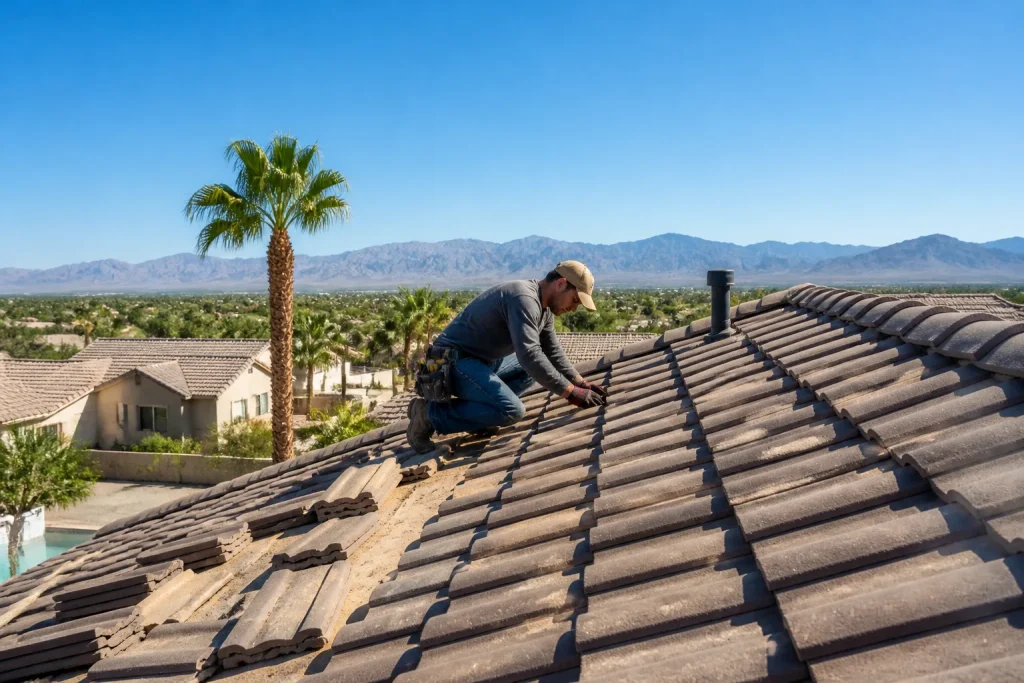
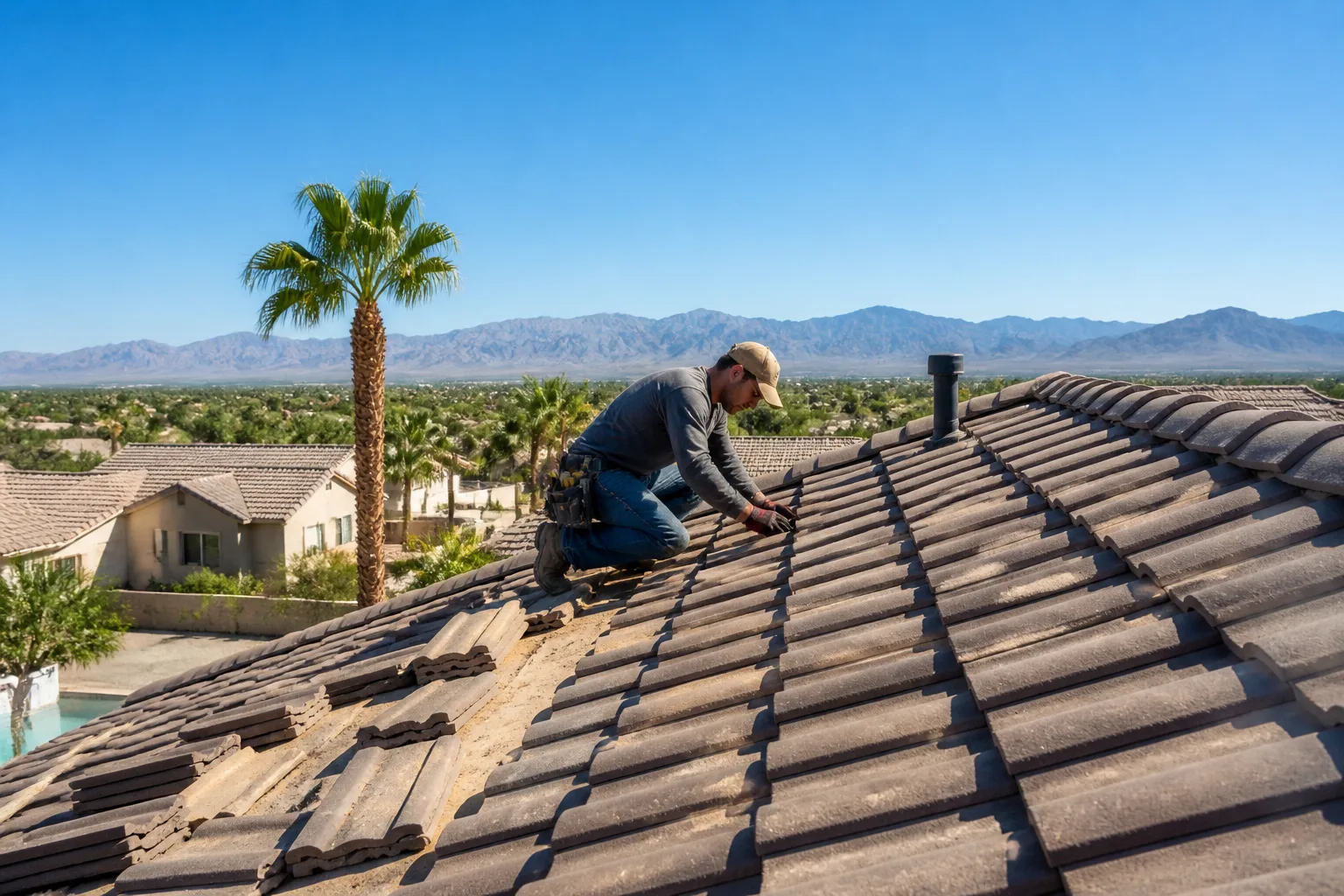
Concrete tile cracks under a boot in the wrong spot. That’s the plain truth. A tile roof is a system where each piece overlaps and rests on the one below, and every step on the wrong part of a tile transfers weight straight down onto a piece that was never meant to carry it. What starts as one cracked tile turns into a spiderweb of hairline fractures that only show up after the next rain.
A qualified tile roofer does a few things differently than someone who mostly works with asphalt:
- Walks the valleys and the flat lines rather than stepping across the field of tile, spreading weight where the framing can take it.
- Uses a tile hook or a walking board to lift and set pieces without levering against a neighbor.
- Keeps a stock of matched replacement tile on hand so a broken piece gets swapped the same visit, not a month later.
- Knows which fasteners hold – tile gets nailed or screwed at the head, and the wrong length punches through the underlayment below.
In our experience, the roof with three cracked tiles after a storm is often fine. The roof with three cracked tiles and forty hairline fractures from a repair guy who walked it wrong is a bigger job. That’s why a roofer who mostly sets composition shingles, like Owens Corning or IKO products, can be a fine roofer and still be the wrong call for tile. The skill set doesn’t fully carry over.
The Underlayment Reality on Paradise Tile Roofs
Here’s the thing most Paradise homeowners don’t hear until it’s too late. On a concrete tile roof, the tile is the rain screen, but the underlayment is the actual waterproofing. Most original tile installs in Paradise went down with 30-lb felt underneath, and that felt has a design life of roughly 20 to 25 years in our climate. The tile on top can look perfectly serviceable while the felt underneath has dried, cracked, and turned to tissue paper.
That’s why a tile-only repair so often misses the real problem. You patch a leak by replacing a broken tile, but the water was never getting through the tile – it was getting through the felt and running down the deck. We see this constantly on Paradise roofs from the late ’90s and early 2000s. The tile is fine. The waterproofing layer under it is done.
What that means for you:
- A leak near a valley or penetration deserves a look at the underlayment, not just the tile above it.
- If a roofer quotes you a tile swap without checking the felt, ask them how they plan to verify the waterproofing.
- A full tile-lift-and-relay (tiles come up, new underlayment goes down, original tiles get set back) is often the honest answer on a 25-year-old Paradise roof.
This is also where the type of tile matters. Boral tile is heavy and durable, and it’s meant to be lifted and reused, which is one reason a proper relay is even possible. Cheaper tile tends to crack on removal.
Boral Warranty: Materials Claim vs. Workmanship Claim
Boral’s warranty coverage on tile is generally solid for the tile itself, but the fine print splits claims into two very different buckets. Getting this straight saves you a lot of frustration.
Materials claims cover the tile product – fading, manufacturing defects, and premature failure of the tile itself. For these you’ll want your original purchase documentation, the product name or profile if you can identify it, and proof of the install date. If you bought the home with the roof already on it, the paperwork may live in your closing file or with the previous owner. Boral’s current warranty terms are worth pulling directly from them, since terms have shifted over the years and the Monier-era documents aren’t identical to today’s.
Workmanship claims cover how the tile was installed – alignment, fastening, flashing, underlayment. That’s on the original installer, not Boral. If your installer is gone (and after 25 years they usually are), the workmanship side of the warranty is effectively dead, and a materials claim won’t cover an install failure.
Our advice: gather whatever paperwork you have before you call anyone for a repair. A roof with a documented install and a matching tile stamp is a much easier warranty conversation than one without.
How We Approach Tile Repair Differently Than Shingle Work
When we get a call for Boral roof repair in Paradise, the first thing we do is walk the roof the way a tile roof wants to be walked, not the way a comp shingle roof gets walked. That sounds small. It’s the whole ballgame. We stay on the valleys, use hooks to lift pieces rather than prying them, and we bring matching tile in case something cracks on the way up.
Specifics of how this plays out on a Paradise tile job:
- Tools. Tile hooks, a soft-face mallet, and a mortar bag. Not a nail gun and a pry bar.
- Walking paths. We map them before we step up, so we’re not improvising across a field of brittle concrete.
- Mortar matching. Ridge and hip repairs need a mortar mix that matches the existing color and cures consistently in our dry heat. A bright gray patch on a 20-year-old roof looks like a scar.
- Flashing. Tile flashing gets set behind the tile and sealed to the deck, and it has to move with the roof as it expands in the summer heat. Comp shingle flashing rules don’t transfer.
If you want to see how we handle the broader roofing picture, our Shepherd & Sons Roofing Paradise home page covers the full scope, and Roof Repair in Paradise is where we break down the repair side in more detail. For roofs that have gone past a repair, Roof Replacement & Installation in Paradise walks through the replacement conversation, and Metal Roofing in Paradise is there if you’re weighing a different material altogether.
When to Call a Pro
Not every tile issue needs a crew. A single cracked tile with no water showing inside is often a small fix. But some situations need trained eyes, and it’s cheap to get a second set of them:
- Water stains on a ceiling or in the attic after a rain.
- Tiles that have slid, lifted, or lost their mortar along a ridge or hip.
- Any leak that keeps coming back after a repair – that’s your underlayment talking.
- A roof past its 25th year where the tile looks fine and the waterproofing underneath is suspect.
Walking a tile roof, especially a steep one, is a genuine fall hazard. Tile breaks without warning, and the wrong step sends you through a skylight or off an eave. This is not a chore for a homeowner with a ladder and good intentions. Call a pro.
The Bottom Line
Boral tile roofs in Paradise are built to last, and the tile itself usually holds up beautifully. The failure point is nearly always the underlayment beneath it, or a repair done by someone who doesn’t understand how tile moves, walks, and flashes. If you’ve been told your tile roof just needs a couple of pieces swapped, ask the question that matters: what’s happening under the tile? That’s where the real answer lives.
The best way to know what you’re working with is to have someone who knows tile take a look. Shepherd & Sons Roofing Paradise offers free estimates – call (833) 676-0557 to schedule yours. We’ll show you what we find before we talk about price.
Frequently Asked Questions
How do I tell if my roof is Boral tile? Check the back or the exposed edge of a tile for a “MONIER” or “LIFETILE” stamp; those profiles carried over under the Boral name after the acquisition, so a Monier stamp usually means a Boral product. The tile’s shape, color, and pitch are the other tells. Call (833) 676-0557 if you want us to identify it in person.
Can you repair Boral tile without replacing the whole roof? Yes, in most cases. Cracked or slipped tiles get swapped individually, and flashing and ridge repairs are routine. The catch is the underlayment beneath. If the felt is past its design life, a tile-only repair can leave the real leak in place. We check both layers before we quote a fix.
What’s the difference between a Boral materials claim and a workmanship claim? A materials claim covers the tile product itself and needs your purchase and install documentation. A workmanship claim covers the installation and falls on the original installer, not Boral. If that installer is gone, the workmanship side is usually closed. Call (833) 676-0557 and we’ll help you sort which pile you’re in.
Why do tile roofs leak even when the tiles look fine? Because the tile is the rain screen, not the waterproofing. On most Paradise roofs the actual barrier is the 30-lb felt underneath, and once it’s past roughly 20 to 25 years it cracks and fails while the tile above still looks solid. That’s the leak you’re chasing.
Written by the team at Shepherd & Sons Roofing Paradise.
Need Roofing Help?
Call Shepherd & Sons Roofing Paradise - licensed & insured, here with fast after-hours help in Paradise.
(833) 676-0557