
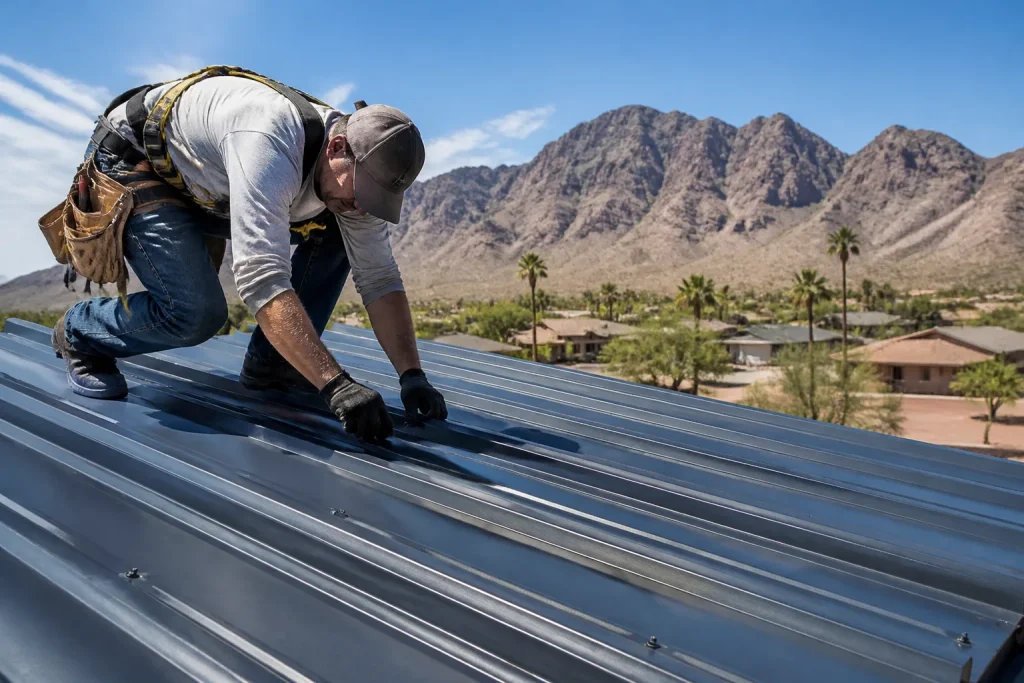
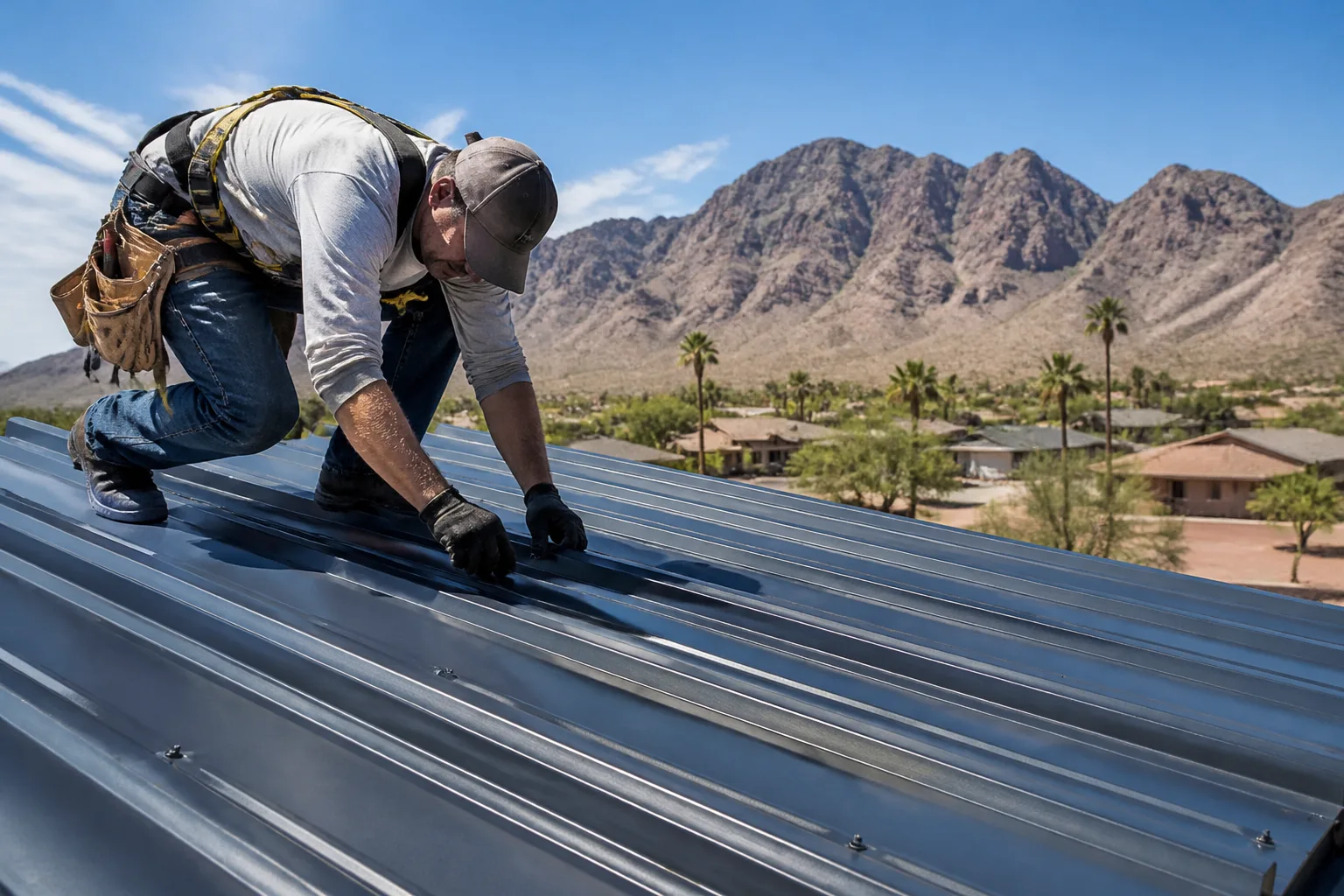
5 Mistakes to Avoid With Metal Roofing
The single most common metal roofing mistake in Paradise, NV is installing standard roofing underlayment instead of a high-temp synthetic rated for 240°F or higher. That substitution fails silently, and on a Paradise roof deck you’ll start seeing the consequences within five years. Alkaline dust, monsoon debris, and extreme thermal cycling expose weaknesses that generic contractor advice never mentions because most of that advice was written for cooler, wetter climates. If you’d rather have a Paradise roofer look at your deck and drainage before you sign anything, call (833) 676-0557 and we’ll come out.
Mistake #1: Using Standard Underlayment Under a Metal Roof
This is the mistake we see most often around Paradise, and it’s the one that costs the most because it’s hidden. Standard 15-pound felt or entry-level synthetic underlayment wasn’t built for what happens under a dark metal panel when the Paradise sun sits on it all July. Under a metal roof, the deck can run 40 to 60 degrees hotter than the air temperature. Felt dries out, cracks, and loses its ability to shed water. Cheap synthetics off-gas and go brittle, and the wrinkles that form create channels where condensation collects.
A high-temp synthetic membrane rated for 240°F and above holds up under that same condition. It costs more per square, maybe a couple hundred dollars extra on a typical Paradise house, and it’s the difference between a metal roof that lasts its full service life and one that has to be torn apart at year six to fix a rot problem nobody could see.
- Ask your bidder directly: “What underlayment, and what temperature rating?” If the answer is vague, that’s your answer.
- Look for the spec sheet. A real high-temp product has a published rating. Felt doesn’t.
- Check the valleys and the low-slope sections first. That’s where the cheap stuff fails earliest.
We pulled the deck off a job outside Paradise last spring where the underlayment had turned to something closer to newsprint than a moisture barrier. The metal panel above it looked perfect. That’s how this mistake works: it hides.
Mistake #2: Ignoring Thermal Expansion Clearances at Penetrations
Metal moves. In Paradise, where we swing from cold winter nights to triple-digit summer afternoons, a 20-foot metal panel will expand and contract more in a single year than the same panel would over several years in a milder climate. Every penetration on that roof – HVAC curbs, pipe boots, skylights, vent stacks – needs a gap tolerance built in for that movement. Generic installs skip it because in other climates they get away with it.
What happens when those clearances are too tight? The panel pushes against the flashing, the sealant fatigues, and you get a slow leak that shows up months later at a completely different spot than the penetration. We’ve traced leaks in Paradise back to an HVAC curb three bays away from where the water was staining the ceiling.
- HVAC curbs need a properly sized gap and a flexible transition, not a hard mechanical connection.
- Pipe boots should be set with room for the panel to slide, not clamped tight against it.
- Skylights need a curb height and flashing detail that accounts for the expansion range, not just the average.
Ask any bidder how they handle a penetration on a hot day versus a cold morning. The good ones have a specific number. The rest will hand-wave.
Mistake #3: Mixing Incompatible Metals for Flashings and Fasteners
Here’s the one that eats a metal roof from the inside. When you put aluminum flashings or fasteners against a steel panel, you’ve created a galvanic cell. Add moisture and the alkaline dust that settles on every roof in Paradise, and you’ve got a corrosion path that will eat through a fastener head in a few years. The panel itself is fine. The fasteners and flashings fail, and then the roof fails.
Paradise’s dust is alkaline, and when it mixes with our occasional rain it becomes a mildly corrosive solution sitting right where the two dissimilar metals meet. Great environment for growing tomatoes, terrible environment for aluminum touching steel.
- Match the metals. Steel flashing with steel fasteners, aluminum with aluminum, or isolate the contact with a barrier or gasket washer rated for the application.
- Look at the fastener heads. Painted steel screws with a proper EPDM washer are standard; cheap electro-galvanized fasteners are not built for alkaline conditions.
- Watch the gutter and drip edge. That’s where mixed metals sneak in without anyone noticing.
You can’t see galvanic corrosion until it’s severe. By the time a homeowner in Paradise notices streaks or rust stains, the fasteners are already compromised.
Mistake #4: Skipping the Monsoon Debris and Drainage Plan
August downbursts in Paradise are not the rain most of the country pictures. Twenty minutes of water coming down fast, plus a year’s worth of dust, pine needles, and roof grit washing into every low point. A low-slope metal roof without a proper drainage calculation doesn’t shed that water – it stores it.
We’ve seen it on Paradise roofs where the panel looks fine from the street and current ponding has quietly worked its way under the laps. Standing water plus metal panels equals rust at the cut edges, sealant failure at the laps, and eventually a leak that shows up in the ceiling two rooms away from the actual problem.
- Calculate the drainage, not just the panel runs. Slope, valley placement, and outlet size all work together.
- Plan for debris. A metal roof with a flat pan against the house wall and no path for needles and grit is a trap, not a roof.
- Look at the gutters and downspouts. Undersized gutters on a low-slope metal roof turn a monsoon into an overflow event.
Before a Paradise install, we walk the drainage on paper first. If the numbers say water will sit anywhere for more than 48 hours after a storm, the design changes before nails go in.
Mistake #5: Choosing a Contractor by Panel Price Instead of Seam Method
Two metal roofs can cost the same per square and perform completely differently, because the price is often quoted on the panel and not the seam. Snap-lock panels are faster to install and cheaper per square, and they rely on the seam clip and the sealant inside it to stay tight. Mechanically seamed panels are crimped closed by a machine that runs the length of the roof. Under Paradise’s thermal cycling and monsoon winds, that difference is the whole ballgame.
Snap-lock on a Paradise roof isn’t automatically wrong – plenty of homes out here do fine with it – but it has to be specified against the actual wind and expansion loads. On longer panel runs and higher-wind exposures, mechanically seamed panels hold up noticeably better. A bidder quoting the same number for both is telling you they haven’t looked at your roof.
- Ask which seam method, and why. “We’ll see when we get up there” is not a plan.
- Ask for the panel manufacturer and the wind rating. A roof is measured in squares – ask any bidder how many they counted and what the rated uplift is.
- Look at the panel length. Longer panels mean more expansion, which pushes toward a mechanical seam.
Ask for the spec on paper before you talk money. The nailing pattern and the seam method earn the wind rating, not the shingle or panel wrapper.
When to Call a Pro
We’re happy to tell you when a metal roof job is a one-day homeowner question and when it isn’t. But if your roof is leaking, if you’re getting a replacement bid, or if you’re questioning what’s already on your Paradise home, call a pro. Standing on a metal roof deck and pulling panels is work that goes wrong fast, and the fix is more expensive than the original bid.
We cover Paradise for metal roofing as its own specialty, and the other work most Paradise homeowners need sits alongside it: Roof Repair in Paradise, Roof Replacement & Installation in Paradise, and the full Metal Roofing in Paradise overview, plus everything else we do at Shepherd & Sons Roofing Paradise home.
The Bottom Line
Metal roofing is one of the better choices a Paradise homeowner can make, when it’s done for a Paradise climate. The five mistakes that actually cost money here are underlayment rated for the wrong temperature, clearances that don’t allow for thermal movement, mixed metals that start a corrosion clock, drainage that ignores the August downburst, and a contractor who quoted the panel instead of the seam. Fix all five and you get a roof that outlives the mortgage. Miss one and you’re paying for the correction years down the road.
If you’re in Paradise and want a second set of eyes on a bid you’ve already got, our Free Second Opinion on any written estimate is a standing offer, and there’s no trip charge inside our own county. Every job we do is backed by our written 90-Day Done Right Promise, the crew is background-checked and works alongside Bill’s own sons on the roof, and a live person answers the phone any hour – not a call center. Our technicians have up to 30 years of experience, and we install systems from manufacturers like CertainTeed, Owens Corning, IKO, and Atlas. If you’re ready, call (833) 676-0557 for a free estimate.
Frequently Asked Questions
Using standard or entry-level synthetic underlayment instead of a high-temp synthetic rated for 240°F and above. Under a dark metal panel in Paradise’s summer heat, the deck runs far hotter than the air, and cheap underlayment dries out, cracks, and off-gasses within a few years. The metal panel above it still looks fine, which is why the failure is usually discovered only when the deck has already begun to rot. Ask any bidder exactly what underlayment and what temperature rating. Call (833) 676-0557 if you want us to look at a bid.
Both can work on a Paradise roof; it depends on panel length, wind exposure, and how much thermal movement the roof will see. Snap-lock is faster and cheaper per square and relies on the seam clip and sealant. Mechanically seamed panels are crimped closed and hold up better on long runs and higher-wind exposures. A contractor who quotes the same number for both without looking at your roof hasn’t done the work. Call (833) 676-0557 for a free estimate and a straight answer on which fits your house.
Galvanic corrosion. When aluminum flashings or fasteners touch steel panels, moisture plus the alkaline dust that settles on every Paradise roof creates a corrosion cell. The panel itself holds up; the fasteners and flashing details don’t. The fix is matching the metals or isolating the contact with the right barrier and washer, and using fasteners built for alkaline conditions. If you’ve got rust streaks or loose fasteners on an existing metal roof, call (833) 676-0557 and we’ll take a look.
A bid that prices the panel alone leaves out the seam method, underlayment spec, penetration clearances, fastener compatibility, and drainage calculation – the five items that separate a Paradise-ready metal roof from a generic install. Ask for those specs in writing before you compare numbers. A square-foot price without them isn’t a bid yet. Call (833) 676-0557 to schedule your free estimate and get a line-item quote you can compare apples to apples.
Written by the team at Shepherd & Sons Roofing Paradise.
Need Roofing Help?
Call Shepherd & Sons Roofing Paradise - licensed & insured, here with fast after-hours help in Paradise.
(833) 676-0557