
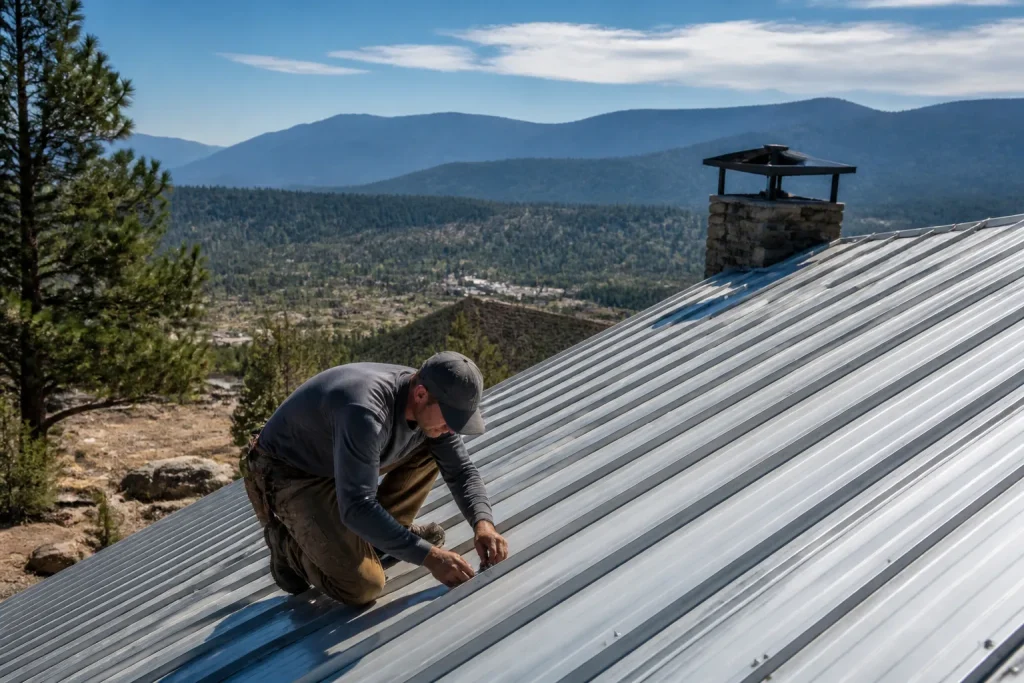
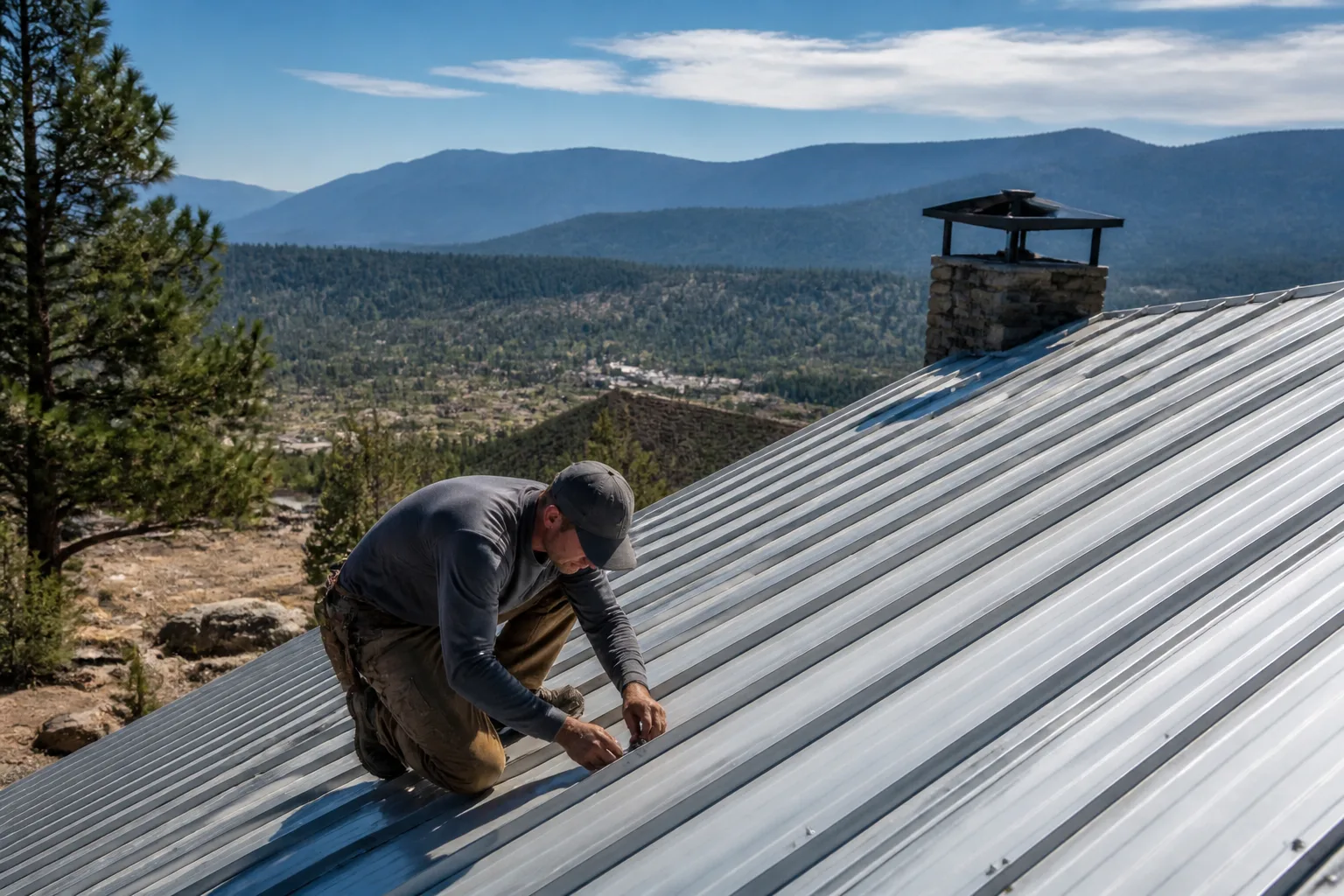
Metal Roofing: Repair or Replace? How Paradise Homeowners Decide
A standing-seam metal roof that lasts 50 years in the Pacific Northwest can show seam fatigue in 15 to 18 years in Paradise. The difference isn’t the metal. It’s the caliche dust, the 115°F summer afternoons, and the daily expansion cycles those temperatures drive through every panel on your roof. That timeline doesn’t appear in most metal roofing brochures, and it’s the reason the repair-or-replace question plays out differently here than it does almost anywhere else.
Repair makes sense when the problem is surface chalking, a failed fastener, or one damaged panel in an otherwise sound field. Replacement starts making sense once coating delamination or galvanic corrosion has reached the substrate – at that point you’re not fixing a leak, you’re managing a slow structural decline. If you’d rather have trained eyes on it before you decide, call (833) 676-0557 and we’ll take a look and show you the panels up close before we talk money.
What’s the difference between cosmetic chalking and coating delamination on a Paradise metal roof?
Chalking is surface-level. Delamination goes down to the metal. That’s the short answer, and it’s the single most useful distinction a Paradise homeowner can learn, because the two problems look similar from the ground and get priced very differently.
Every painted metal panel – whether it started as a Kynar 500 finish or a polyester coating on a budget panel – sheds a thin layer of pigment over time. In alkaline desert air, caliche dust settles on the panels and holds moisture against the surface longer than it would in a wetter climate. That trapped dust accelerates the chalking. You’ll see a white, powdery film that wipes off on your finger. Chalking is cosmetic. It doesn’t leak, and it doesn’t mean your roof is failing.
Delamination is different. Run your hand along a panel edge or a seam and look for coating that’s curling, flaking, or peeling away in sheets, revealing bare metal underneath. That bare metal is the problem. Once the coating barrier is gone in Paradise’s sun and dust, the steel or aluminum starts oxidizing at the panel edge, and oxidation creeps under the remaining paint. A telltale we’ve seen plenty of times: the chalky film stops wiping clean and starts coming off in ribbons with the paint attached.
- Chalking (repairable): powdery film, wipes off, no bare metal, no edge curl.
- Delamination (replacement trigger): peeling coating, visible bare metal, edges lifting at seams or fasteners.
- Rule of thumb: if the coating is intact, a clean-and-seal or a spot repair is usually worth it. If the coating is gone, you’re patching a losing battle.
Why does galvanic corrosion at fastener points matter so much in desert installations?
Galvanic corrosion happens when two dissimilar metals touch in the presence of moisture and an electrolyte, and the less noble metal gets eaten away. In Paradise, where caliche dust and irrigation overspray can carry salts onto the roof, that reaction moves faster than most installers plan for.
The common failure point is the flashing. A metal roof’s field panels might be a high-quality coated steel or aluminum, but the flashing around a chimney, a skylight, or an HVAC curb is sometimes a different metal – often a bare galvanized or a copper piece that doesn’t play well with the panel. Then you add a stainless fastener and a screw washer, and now you’ve got three different metals in one intersection. Every temperature swing in Paradise drives moisture in and out of that joint, and the reaction builds.
What you’ll see: rust stains streaking down the panel from a fastener, or a fastener head that’s rusted but the panel around it looks fine. That’s a repair candidate – swap the fasteners, reflash the curb with a compatible metal, and seal the penetration properly. What you don’t want to see: the panel itself corroding around the fastener hole, where the hole has widened and the panel edge is thinning. That’s the point where each new leak is a symptom of a larger pattern.
An HVAC curb is a specific Paradise concern. Desert homes run their AC hard from May through October, and a poorly flashed curb flexes and sweats with every cycle. If the installer used a mismatched metal on that curb, you’ll find the problem there first. When we’re on a roof, we check every curb and penetration, not just the panels.
The panel expansion math: why 115°F matters more than your warranty says
Metal expands when it heats. A 16-foot standing-seam panel installed at a 60°F morning temperature and heated to 115°F in the afternoon grows – not by a lot in absolute terms, but enough that the clips and seams have to absorb the movement. Manufacturer specs assume a certain range, and in Paradise you’re often at the top of it, sometimes past it.
Standing-seam panels are designed to float. The clips that hold them down are supposed to let the panel slide as it expands and contracts, and that’s what keeps the seams from tearing. When the clip spacing is off, when the panels are over-fastened, or when the seam was crimped too tight, the panel can’t move the way it was designed to. Over a few thousand heating cycles – which a Paradise roof accumulates faster than almost anywhere – you get seam fatigue. You’ll see it as a slight lifting at the seam edge, a hairline crack behind the crimp, or a panel that’s started to oilcan (flex visibly when you press on it).
This is the number that gets left out of the sales pitch. A roof that sees a 55°F swing every day moves more in 15 years than a coastal roof moves in 40. That’s why “50-year standing seam” and “your Paradise roof” aren’t the same sentence.
Seam fatigue is repairable when it’s caught early – reseating a clip, re-crimping a seam properly, or swapping a single panel. Once the seam is tearing and the panel edges are out of plane, replacement math starts to beat repair math. If you’re not sure which side of that line your roof is on, the crew at Metal Roofing in Paradise can walk the panels with you.
When does a partial panel replacement make sense – and when does it backfire?
A partial panel replacement works when the failed panel is isolated, the surrounding panels are sound, and you can get a replacement panel in the same profile, gauge, and finish. Do that, and it’s the cheapest repair on the menu.
The backfire case is when the panel can’t be matched. Metal roofing profiles change. Colors fade in the Paradise sun, and a panel from a discontinued color run won’t match the field no matter what the swatch says. Worse, a new panel on an old roof expands and contracts at a slightly different rate than panels that have been on the roof for 15 years, so it moves against its neighbors and can open the seam it was supposed to fix. We’ve seen partial replacements that solved the original leak by creating two new ones at the adjacent seams.
Here’s the practical test:
- Is the panel still made? Same profile, same gauge, same finish. If not, partial replacement is a coin flip.
- How many panels are affected? One panel in an isolated spot is a repair. A cluster near a valley, a curb, or a chimney is usually a systemic problem.
- What’s the panel age? Under 10 years in Paradise, a partial is usually fine. Past 15 years, a mismatched patch is often setting you up for the two-new-leaks problem.
- Is the substrate sound? If the decking under the failed panel is rot or water-stained, the leak wasn’t the panel’s fault and the patch won’t fix it.
If the answer to those points at replacement, an installation in Paradise that uses matched panels and desert-rated clips will usually cost less over 20 years than two rounds of mismatched patching.
What should you ask a metal roofing contractor in Paradise before you hire them?
Ask about desert experience, not general roofing experience. A contractor who’s installed a hundred metal roofs in Washington has installed a hundred metal roofs that don’t see what your Paradise roof sees. The questions below expose that gap in about three minutes.
- “What clip spacing do you spec for a 16-foot panel in this climate?” A contractor with desert experience answers without hesitation. A contractor who doesn’t has to call somebody.
- “What metal do you use on HVAC curbs?” The answer should be a metal that won’t react with the panel. If they say “whatever’s standard,” that’s your answer.
- “How do you handle caliche dust during installation?” Cleaning the panels before sealing and knowing how the dust affects the sealant matter here more than anywhere else.
- “Have you done a repair on this profile before?” Ask them to point to one locally. If they can’t, the panel match is a risk.
- “What’s in writing, and what’s the workmanship promise?” Get the scope, the panel spec, and the warranty terms in writing before anyone touches the roof.
We install metal products from Owens Corning, IKO, Atlas, and Tamko, and we’ve been setting these panels in this climate long enough to know which ones hold up and which ones chalk early. Your roof isn’t the place to find out a product doesn’t like alkaline dust.
When to call a pro: one fastener is a homeowner problem. A panel seam under tension, a curling panel edge, or corrosion at a fastener hole is not – a roof panel that lets go under expansion can slice through anything in its path, and the fall is worse. Call us instead.
Related services in Paradise: Roof Repair in Paradise for fasteners, flashing, and isolated panel work, and our Shepherd & Sons Roofing Paradise home page for everything we do.
The Bottom Line
In Paradise, metal roof repair makes sense when you’ve got chalking, a rusted fastener, one damaged panel in an otherwise sound field, or a flashing problem that a compatible-metal reflash will solve. Replacement starts making sense when coating delamination is exposing the substrate, when galvanic corrosion is eating panel edges at the fastener holes, or when seam fatigue has progressed past re-crimping. The 15-to-18-year timeline is the one to keep in your head, because it’s shorter than the brochure promises and it’s the timeline your roof is actually on.
If you’re in Paradise and need a straight answer, Shepherd & Sons Roofing Paradise offers free estimates. We’ll show you the deck photos and the panel edges before we talk money. Call (833) 676-0557.
Frequently Asked Questions
Most metal roof repairs in Paradise run between $450 and $1,800, depending on what’s failed. A fastener reflash or a small curb repair sits at the low end. A single panel replacement with a matching profile runs higher, and corrosion repairs that involve more than one intersection can go beyond that range. Call (833) 676-0557 for an exact quote – estimates are free.
No. Chalking and delamination look almost identical from the street, and the difference decides whether you’re spending a few hundred dollars or several thousand. The roof has to be walked, and the panel edges, seams, and fastener points have to be checked up close. A contractor who quotes replacement from the driveway hasn’t seen the roof.
Not if the contractor quoted properly. We give a written line-item quote before any work begins, and the number on that quote is the number you pay. If we find something under the panels that changes the scope, we stop and tell you before proceeding – never after. Call (833) 676-0557 to get your written estimate in hand first.
In this climate, a well-installed standing-seam metal roof typically holds up 25 to 35 years before it needs major attention, and it can show seam or coating problems at 15 to 18 years. A quality asphalt shingle roof in Paradise generally runs 18 to 25 years. Metal still wins on lifespan, just not at the 50-year figure you’ll see quoted for wetter climates. Call (833) 676-0557 to have your roof’s actual age and condition assessed – the free estimate will tell you which side of the line you’re on.
Written by the team at Shepherd & Sons Roofing Paradise.
Need Roofing Help?
Call Shepherd & Sons Roofing Paradise - licensed & insured, here with fast after-hours help in Paradise.
(833) 676-0557